
From Blueprint to Takeoff: Understanding the Strict Regulatory Framework of Aerospace Tooling

The Invisible Foundation of Flight Safety
In the aerospace industry, the journey from a design blueprint to a certified aircraft is governed by an unwavering commitment to safety. This commitment extends beyond the plane itself, reaching down to the very tools used in its manufacture and maintenance (MRO). The regulatory framework—a complex web of international and national standards—ensures that every rivet is set correctly and every component fits perfectly. At USATCO, we recognize that compliance begins with choosing a partner whose quality management meets these non-negotiable industry demands.

The Cornerstone: ISO 9001 and AS9100 Standards
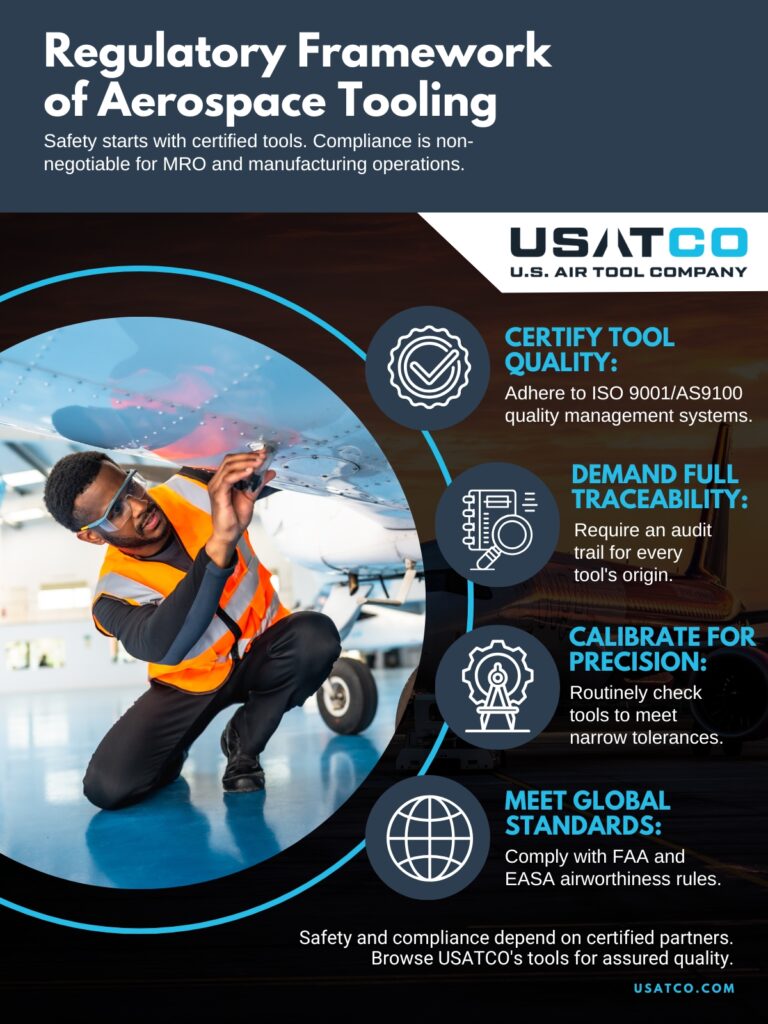
For a tooling supplier, adherence to internationally recognized Quality Management Systems (QMS) is paramount. ISO 9001 provides the framework for effective quality control, which USATCO has proudly achieved. However, the aerospace sector requires the specialized AS9100 standard, which builds upon ISO 9001 with requirements specific to aviation, space, and defense organizations. These standards mandate robust, repeatable processes, ensuring that the tools delivered are consistently manufactured and distributed to the highest possible quality benchmarks.

Full Traceability: The Audit Trail of Every Tool
Regulatory bodies demand a complete, unbroken chain of evidence for every operation performed on an aircraft. This concept of traceability means that not only the aircraft components but also the certified tools used to install or maintain them must have a clear audit trail. From the raw materials of a drill bit to the calibration certificate of a torque wrench, documentation is required. This practice ensures accountability and allows for rapid identification and mitigation of issues should a defect arise in the production or MRO process.

Calibration, Certification, and Precision Maintenance
In aerospace, “close enough” is never acceptable. Tools that set fasteners, measure gaps, or apply specific forces must operate within extremely narrow tolerances. Therefore, tool calibration and certification are critical regulatory requirements. Every measuring and setting tool must be routinely checked against master standards to confirm its accuracy. This scheduled maintenance prevents tool drift, safeguarding the precision of the work and maintaining the aircraft’s airworthiness certification.

The Oversight: FAA, EASA, and Global Compliance
The core regulations are dictated by powerful governmental bodies, notably the Federal Aviation Administration (FAA) in the U.S. and the European Union Aviation Safety Agency (EASA). These agencies set the rules for airworthiness, which directly influence the acceptance criteria for MRO facilities and manufacturing OEMs. Any tool or component that enters the lifecycle of an aircraft must comply with the standards set forth by the relevant authority, making global compliance a continuous focus for international distributors like USATCO.
Shop Professional-Grade Aerospace Tools
The strict regulatory framework of aerospace tooling is not an obstacle; it is the vital mechanism that guarantees the safety of modern flight. Partnering with a distributor who is deeply committed to ISO quality and understands the demands of global traceability is essential for maintaining compliance and operational integrity.
Equip your team with the highest quality, professional-grade tools designed for safety and endurance. Browse USATCO’s ISO-certified selection today!